
How to Plan a 3 Month Trip Abroad
Planning a short getaway is one thing, but a trip that stretches over three months or more? That’s a whole different ballgame. The stakes are higher, the planning more detailed, and the peace of mind you’ll get from being well-prepared is priceless.
When I first started planning my upcoming trip to Italy, I booked my flight in January, scheduled activities, and began an itinerary outline months ahead of departure. The said itinerary is saved to my email drafts for ease of editing/updating. It’s not the first time I’ve lived abroad for an extended period, nor the first time I’ve planned for such experiences. It is the first time I feel better equipped and informed to do so.
*Some links are affiliate links—I may earn a small commission if you purchase, at no extra cost to you.*
Sort Out Your Travel Preferences First
Now, I don’t pretend to hold the holy grail of trip planning, but I know what works for me. So, before we get much further, let me give a bit of insight into my traveling style. This way, you can decide how much to incorporate into your own planning or to take with a grain of salt while considering your own traveling style.
Peace of mind is always a priority
This means avoiding one- to two-hour layovers at Paris’ Charles de Gaulle Airport from LAX. It must exceed two hours at least. This also means paying the extra fees for picking a seat on the airplane (in front of the wing is preferable).
I like hidden gems, road-less-traveled things
(Hence the name of this blog), and especially if I’ve already been to the destination. In other words, I’d much rather take a guided haunted tour of Florence’s sordid past or saunter through an old cemetery than explore the Accademia. No offense, David – I thoroughly enjoyed the sight of you in 2023.
Food, food, wine, food, and wine
I’m interested in everything from a hole-in-the-wall family eatery that doesn’t see a lot of tourists to a Michelin-rated delight. And best believe, if Anthony Bourdain has been to said destination, I’ll research what his favorite spots were and try to go there, like the time I ended up at one of the most memorable sushi dinners at the now-closed Yasuda, in Japan.
Planning is essential
But not too much planning that you have no time to get lost or rest. Leave some days and hours open to whatever you feel like doing at that time. If that involves wandering and getting lost, even better.
Decide what the goal of your stay is
My goal is to live like a local. This means doing a lot of my own cooking, which means accommodations with a kitchen were essential. This also means one place to call home base and hotels for weekend getaways.
While there are others, let’s consider the above preferences. Most of my planning is going to revolve around food and wine and off-the-beaten-path experiences, but not at the detriment of my peace of mind. If said experience requires two buses, seven trains, and thirty-two plus hours of travel, it’s probably not for me. And yes, I speak from experience.
Maybe your preferences revolve around the macabre, and you eat to live, not live to eat. Or perhaps you’re only about fine dining with a budget to support this preference. Either way, making a simple list like the one above and outlining what it is you want to focus on will guide your research and planning. It should also be noted that I’ve successfully planned trips for folks whose travel style is not like mine.
Pre-Extended Travel Checklist
Before packing, nail down the basics: passport, visas, vaccination records, driver’s license, and any necessary permits. Make digital copies of these VIP docs. Keep them in a secure cloud location that’s easily accessible. Don’t just store them on your phone. A survey revealed that 20.2% of people had their phones stolen on holiday, while 23% reported losing their device abroad.
Notify your bank and credit card companies. Some don’t require you to do so. I specifically bank with Capital One because all of their cards are foreign-transaction-friendly. In other words, no fees for purchases or ATM transactions. Exchange some of your country’s currency for the destination country’s currency. While most of the world has moved toward non-cash environments in the post-COVID era, it’s always a good practice to have some cash on hand. Plus, I find that many of the smaller mom-and-pop establishments you’ll likely find while wandering prefer cash.
Finally, stock up on medications, vitamins, schedule checkups, and check insurance coverage, especially if you’re leaving your home country. International travel insurance is definitely a good idea, especially if you have any chronic or lingering health concerns.
Getting these ducks in a row early on will reduce stress later. It will keep you from scrambling at the last minute and prevent you from forgetting something essential. I find making a list and checking it off as things are completed very helpful.
Packing Tips for Extended Trips
For trips longer than a couple of weeks, embracing the art of minimalist packing or investing in and paying for a durable second bag to check is ideal. Your packing will heavily rely on the time of year. If it’s summer, packing light is a lot simpler. If it’s nearing the colder months, you’re inevitably going to need more space.
For me, it would be impossible to fit a winter coat, enough sweaters, bottoms, layers, and accessories into a large backpack like the one I used for a nine-day solo trip to Japan. My solution? I bought an Amazon Basics suitcase with thousands of fabulous reviews in the max size the TSA allows. I will be checking this bag with some essential full-size toiletry needs, as well.
I also recommend getting a stuffable travel pillow. If you know me, you know I love multi-tasking, dual or multi-purpose items. Building a tiny home really instilled this for me.
Travel is a fast-track portal to unimaginable growth, new perspectives, and a mind that remains open.
The Road Linds Travels Tweet
A Few Key Points for Packing Smart
Keep in mind that you’ll likely pick up things along the way. Packing smart means prioritizing what truly matters.
Focus on versatile, layering pieces you can mix/match. Given my trip is a few weeks away, I picked a day to plan my outfits and took photos so that when it comes time to pack, I know what to pack.
Laptop, phone, chargers, and adaptors. Keep it compact. I recommend backing up important files to the cloud, including making room for the many photos you’re bound to take. Carry a universal adapter and bring a small power bank for long travel days.
Lightweight backpack or carry-on, reusable water bottle, journal, and any personal comfort items you can’t live without. Think noise-canceling headphones, or a compact umbrella—little things that make long journeys much more comfortable.
Plan Your Home Front
Leaving for months means taking care of your home life before you go. Start by managing your mail and bills. Set up automatic payments where possible. Ask a trusted friend or family member to check your mail regularly. Look at your subscriptions and services too; pause anything you won’t need while away, such as streaming platforms or wine club memberships.
Pets and plants are a priority. Make arrangements for reliable pet sitters, boarding, or plant care so that everything at home stays healthy and tended to while you’re gone. Fortunately, I use the Planta app, which allows me to add people who can see my plant’s needs day by day and check off what’s taken care of.
By clearing these tasks well ahead of time, you can travel with peace of mind. There’s that expression again. Knowing that your home is looked after and not constantly worrying about what’s happening while you’re away is ideal.
Map Out Your Itinerary While Incorporating Flexibility
You don’t need every hour planned, but having a rough framework keeps long trips manageable, particularly if you intend on visiting more than one city. I find saving a Google map for each destination very helpful. Google Maps allows you to save notes for each place and download them as an offline map, making them accessible even without cell service.
The beauty of long-term travel is the freedom, but a little planning prevents stress, missed opportunities, and wasted time. It helps to have key destinations, transport connections, and accommodations booked for at least the first few weeks. Consider any work or personal commitments and make sure that internet access or other essentials will be available where you’re staying. At the same time, leave some buffer days in your itinerary for rest, unexpected detours, or simply getting lost and exploring; Often, the unplanned adventures are the most memorable.
Prepare Mentally and Emotionally
We’ve discussed the logistics, but did you know that preparing your mind and heart is equally important? A three-month trip can be thrilling, but it also brings its share of unexpected challenges. Being away from home, family, and friends for an extended period can stir up unanticipated emotions, and having strategies in place to handle them makes all the difference.
Entering your trip with a resilient mindset allows you to fully enjoy the adventure and adapt gracefully to whatever comes your way. Here are some key considerations for your mental and emotional prep:
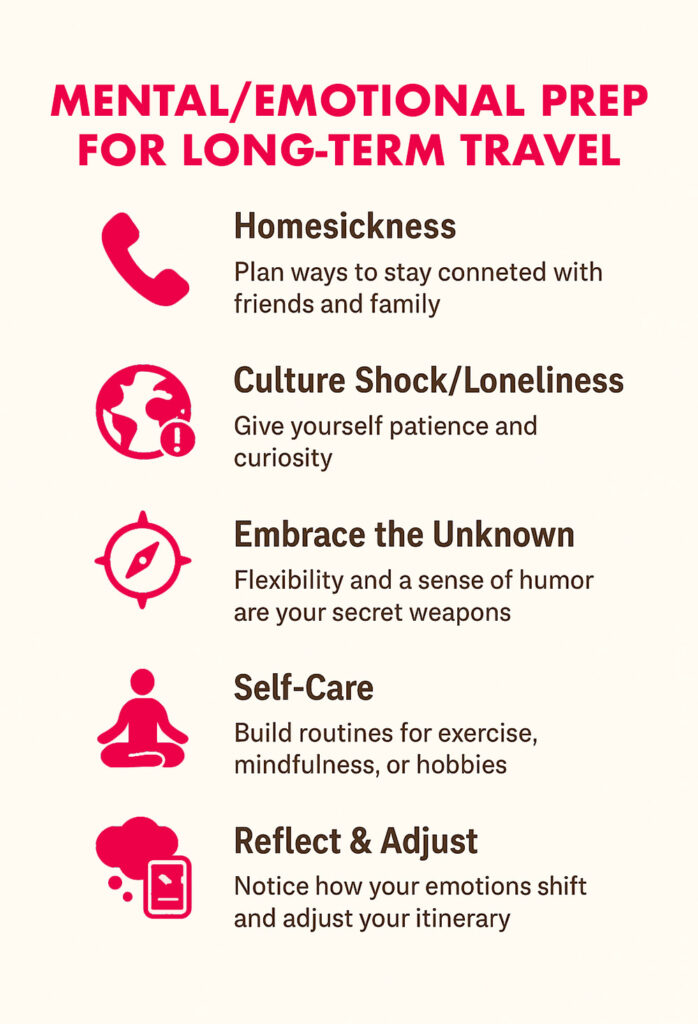
Homesickness is normal: Feeling a little longing for home is expected. Schedule regular calls or video chats with friends and family to maintain connection and support.
Loneliness or culture shock may happen: Traveling for months often means encountering unfamiliar environments and customs. Approach these experiences with patience and curiosity; allow yourself time to adjust.
Embrace the unknown: Not everything will go according to plan. Flexibility, a sense of humor, and a willingness to adapt are your best tools for turning potential stress into memorable experiences.
Self-care matters: Build in routines for exercise, mindfulness, journaling, or hobbies to maintain your mental balance while traveling.
Reflect and adjust: Check in with yourself regularly. Notice how your emotions shift and change your itinerary, pace, or social interactions if needed.
Final Travel Planning Checklist
We’ve covered quite a bit, but not nearly everything that will come up when embarking on such an epic adventure. That said, I’ve compiled a brief list of a few things to consider or keep in mind. These points will vary, depending on your destination.
- Is your passport up to date? Many countries will not allow you to enter if your passport is within six months of its expiration date.
- The United Kingdom now requires Americans to apply for the Electronic Travel Authorization (ETA) before entering any country within the UK.
- The UK is separate from what’s known as the Schengen Area or “Zone.” This distinction allows you to stay in countries within the Schengen Area for up to ninety days every 180 days and in the UK for up to six months with an approved ETA.
- Check whether your destination requires a visa and, if so, how long the application process typically takes. Some countries require visas even for short stays.
- Research any recommended or required vaccinations, and carry proof, if needed. Also, check if your destination has specific health advisories.
- Familiarize yourself with cultural norms, tipping practices, and any laws that may differ from those at home.
- Save local embassy or consulate numbers, local emergency services, and any contacts for accommodations. Engage with the Smart Traveler Enrollment Program (STEP) for added peace of mind – yes, there’s that expression once again.
- Research areas to avoid, local scams, and tips for staying safe as a traveler.
Above all, have a wonderful time! Travel is so much more than being able to say, “I gazed at Michelangelo’s David’s butt until security told me it was closing hour.” Although that wouldn’t be a terrible thing to humble brag about. However, travel is a fast-track portal to unimaginable growth, new perspectives, and a mind that remains open. It’s a river with a dozen tributaries all begging to be swam. Travel is one of the best gifts we can grant ourselves. Buon viaggio amici miei!


Linds
Los Angeles, California
This site uses Akismet to reduce spam. Learn how your comment data is processed.
Leave a Reply